
Turning 41 is a powerful reminder that training is no longer just about working hard. It is about working with purpose and precision. One of the most effective ways to do that is by understanding and applying your maximum heart rate and targeted heart rate zones. Whether your goal is fat loss, strength, joint health, or long term performance, heart rate tracking provides objective data that helps you train at the right intensity on the right day. This article will walk you through how to calculate your max heart rate, the limitations of common formulas, how to use heart rate zones, when to train near max, and where most strength training should occur.
What Is Maximum Heart Rate
Your maximum heart rate is the highest number of beats per minute your heart can reach during maximal effort. It represents your cardiovascular ceiling and serves as the anchor for all heart rate based training zones.
How to Calculate Your Max Heart Rate
The traditional formula is 220 minus your age. For a 41 year old this equals 179 beats per minute. This is the most commonly used method because it is simple and fast, but it can have an error range of plus or minus 10 to 15 beats per minute, which is significant when prescribing precise training intensities.
A more accurate general population equation is 208 minus 0.7 times your age. For a 41 year old this equals 179 beats per minute. Research shows this formula is more accurate across a wider population.
The most accurate method is a graded maximal exercise test performed in a clinical or performance setting. This directly measures your true maximum heart rate and removes estimation error. This is particularly valuable for performance athletes, adults over 40, and clients in structured conditioning programs.
Why Tracking Heart Rate Matters
Heart rate is not just a cardio metric. It reflects internal workload, recovery capacity, aerobic efficiency, nervous system stress, and training readiness. For the 40 plus population, especially active adults balancing career, family, and training, this becomes a critical tool for managing fatigue and progress.
Understanding Heart Rate Training Zones
Zone 1 is 50 to 60 percent of maximum heart rate and is used for recovery and circulation. This is appropriate for warm ups and active recovery.
Zone 2 is 60 to 70 percent of maximum heart rate and is used for aerobic base development, fat oxidation, mitochondrial health, and longevity training. This is the most underutilized and most valuable zone for adults over 40.
Zone 3 is 70 to 80 percent of maximum heart rate and is used for work capacity and cardiovascular improvement.
Zone 4 is 80 to 90 percent of maximum heart rate and is used for high intensity training and lactate threshold development.
Zone 5 is 90 to 100 percent of maximum heart rate and represents maximal effort and short duration intervals.
The Value of Training Near Your Max Heart Rate
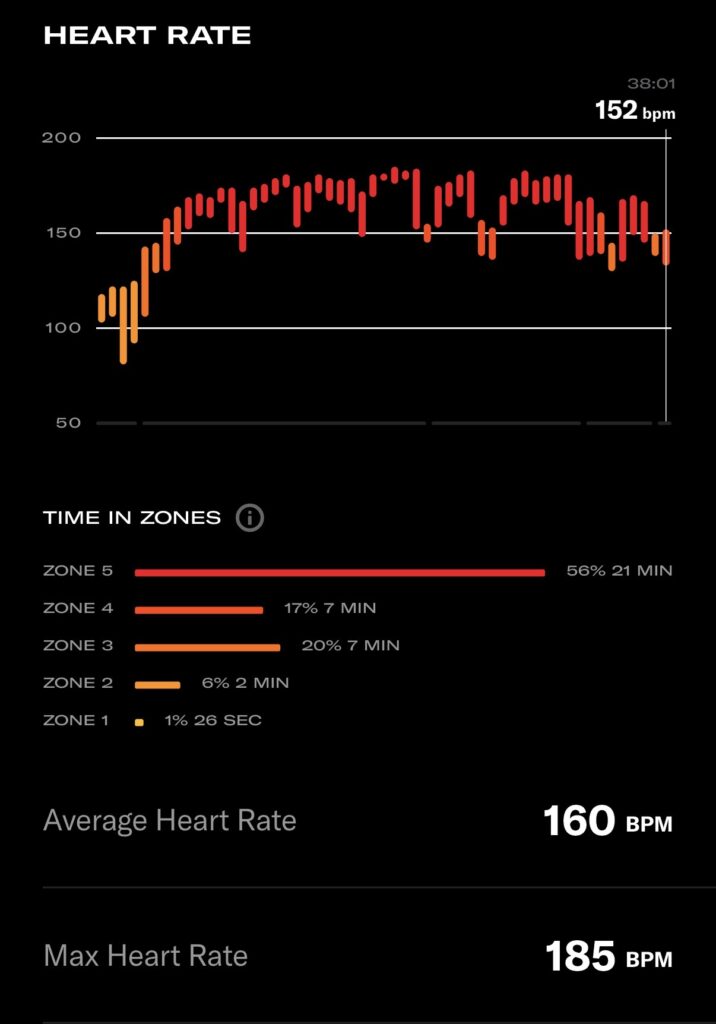
Training near your maximum heart rate is not something to avoid. It is something to use strategically. Benefits include maintaining VO2 max, preserving fast twitch muscle fiber recruitment, improving cardiac output, and enhancing metabolic flexibility. VO2 max is one of the strongest predictors of longevity. This intensity should be used briefly, infrequently, and with full recovery. For most adults one to two short exposures per week is enough. Examples include sprint intervals, assault bike efforts, sled pushes, and loaded carries performed at high speed.
Where Strength Training Should Occur
Most strength training should occur between 60 and 75 percent of maximum heart rate. This range allows for high quality force production, proper recovery between sets, nervous system efficiency, and joint friendly training. If your heart rate is consistently climbing into Zone 4 during strength work it often means the loads are too light, rest periods are too short, or conditioning is limiting strength output. Strength training is a neuromuscular task, not a cardiovascular one. Your heart rate should rise during sets and recover between them.
A Practical Example for a 41 Year Old
The estimated maximum heart rate is 179 beats per minute. Strength training target is 107 to 134 beats per minute. Aerobic base work is 115 to 125 beats per minute. High intensity intervals are 143 to above 170 beats per minute for short durations.
The Longevity Connection
For active adults in their 40s to 70s+, heart rate guided training provides better recovery management, reduced joint stress, higher training consistency, and objective progression markers. Instead of guessing how hard to train, you are using real physiological data.
The goal is not to train hard every day. The goal is to train easy when you should go easy and hard when you should go hard. Heart rate gives you the feedback to do exactly that. This leads to better strength gains, improved conditioning, lower injury risk, and long term sustainability.
At 41, training smarter is the advantage. Knowing your maximum heart rate and using it to guide intensity allows you to push when it matters, recover when it counts, and build a body that performs for decades. This is not just about performance. It is about training for longevity.
American College of Sports Medicine. ACSM’s Guidelines for Exercise Testing and Prescription. https://www.acsm.org
Recent Comments