
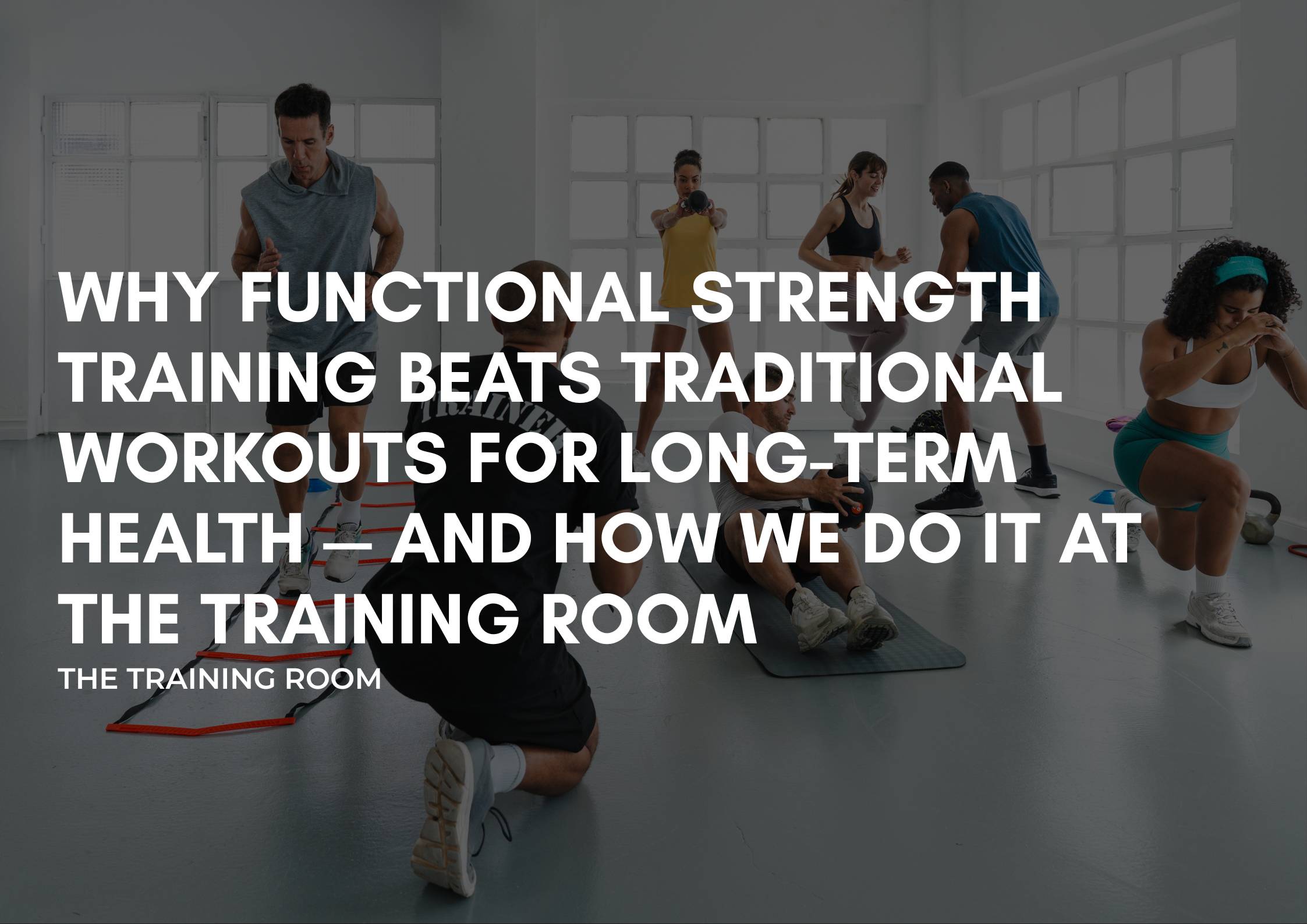
Most adults in their 40s, 50s, and 60s know they should strength train. Yet, not all strength training methods are equal. Exercises, routines, and progressions that work for a 25-year-old often cause pain, injury, or stalled progress for someone in midlife. Traditional workouts—bodybuilding splits, random group classes, or machine-only routines—weren’t designed for aging joints, recovering tissues, or decades of movement habits.
That’s where functional strength training Westerville comes in. At The Training Room, it’s the foundation of every program. Functional training builds the skills, strength, and movement patterns adults need to remain active, pain-free, and independent for decades. With Tonal technology and our Longevity Testing Program, this approach has become even more effective.
Below, we break down what functional strength training is, why it’s essential after 40, and how we use it at The Training Room to help adults move better and feel stronger.
1. What Is Functional Strength Training?
Functional strength training improves the movements you use every day:
- Squatting
- Lifting
- Carrying
- Reaching
- Pushing and pulling
- Rotating
- Balancing
This method strengthens all three planes of motion while stabilizing the core, hips, and shoulders—areas that commonly lose function with age.
Functional training does not focus on:
- Isolating muscles on machines
- Lifting as heavy as possible
- High-volume, fast-paced classes
- Random workouts without progression
It trains your body the way it was designed to move.
2. Why Traditional Workouts Fall Short After 40
Traditional workouts can limit longevity and mobility. Common problems include:
- Overuse of machines → restricted mobility
- High-impact cardio → joint irritation
- Random group classes → lack of scaling
- Bodybuilding splits → not functional for real life
- Heavy barbell programs → higher injury risk
- Poor warm-ups → movement compensations
- Excessive volume → slower recovery
- Neglecting stability → back, hip, knee pain
These routines often build muscle but not the resilience adults need for real-life movement.
3. Functional Strength Builds the Qualities That Matter Most
After 40, key physical abilities include:
- Strength
- Power
- Balance
- Mobility
- Stability
- Coordination
- Muscle mass retention
- Joint integrity
- Aerobic capacity
Functional strength training improves all of these simultaneously, leading to:
- Better independence
- Higher bone density
- Lower fall risk
- Reduced joint pain
- Enhanced mobility
- Improved metabolism
- Increased longevity
- Better overall quality of life
From carrying groceries to playing with grandkids, functional strength supports real-life activities better than traditional workouts.
4. The Science Behind Functional Strength
Research from Harvard, Stanford, and the American College of Sports Medicine confirms that full-body, multi-joint movements produce superior long-term results. Functional training improves:
- Neuromuscular coordination → faster, more efficient communication between brain and muscles
- Joint stability → protects hips, spine, and shoulders
- Movement efficiency → controlled, energy-saving motion
- Hormonal health → supports insulin sensitivity, testosterone, and growth hormone
- Sarcopenia prevention → slows age-related muscle loss
- Fall prevention → improves balance and dynamic control
Functional strength training doesn’t just build muscle—it helps you age better.
5. How Functional Strength Training Prevents Injury
Traditional workouts often load dysfunctional patterns, causing pain. Functional strength fixes movement patterns first, then strengthens safely.
We assess:
- Hip stability
- Core control
- Balance
- Shoulder mechanics
- Squat and hinge patterns
- Mobility limitations
- Strength asymmetries
- Gait and rotation patterns
This leads to:
- Fewer injuries
- Consistent training
- Stronger joints
- Better energy and confidence
Adults often report: “I feel younger, not just stronger.”
6. How We Use Functional Strength at The Training Room
Our approach follows the Repair → Retrain → Reinforce system:
Repair
- Reduce pain
- Improve mobility
- Address dysfunctional patterns
Includes chiropractic care, soft tissue work, dry needling, and joint mobility exercises.
Retrain
- Correct movement patterns
- Rebuild foundational control
Includes core sequencing, hip and shoulder stability, balance, and coordination work.
Reinforce
- Build long-term strength with functional patterns: squat, hinge, lunge, push, pull, carry, rotate
Every session reinforces good movement and minimizes risk.
7. The Role of Tonal in Functional Training
Tonal machines elevate functional strength by providing:
- Adaptive digital resistance
- Reduced joint load
- Safe progression
- Real-time feedback
- Balanced strength development
- Data tracking
- Micro-progressions
Tonal makes functional strength safer and accessible for adults 40+. If someone has knee pain, Tonal reduces joint compression. If someone fatigues early, resistance adjusts automatically.
8. Functional Strength Supports Long-Term Fat Loss
Many adults over 40 struggle to lose fat because low muscle mass slows metabolism. Functional strength training addresses this by:
- Increasing lean mass
- Boosting metabolism
- Improving glucose control
- Reducing inflammation
- Balancing hormones
- Raising daily energy expenditure
- Building strength that encourages more activity
9. Functional Strength Reduces Pain
Adults often fear exercise due to past injuries. Functional training eliminates this fear by:
- Teaching proper mechanics
- Improving joint alignment
- Building stability
- Strengthening connective tissues
- Reducing compensations
- Gradually progressing load
We work with clients with: low back pain, knee arthritis, shoulder issues, hip mobility limitations, tendinopathy, and balance deficits. Functional strength is safe and therapeutic.
10. Why Small Group and Personal Training Programs Focus on Function
Every program at The Training Room is built around:
- Function
- Longevity
- Strength
- Safety
- Progression
- Personalized coaching
- Movement quality
With Longevity Testing, Tonal, and expert coaching, our system provides one of the most complete training experiences in Westerville.
Ready to Train Smarter, Not Harder?
Functional strength training is the key to building strength that improves your life.
Recent Comments