
GLP-1 Medications and Muscle: What the Research Says and What to Do About It
If you've started Wegovy, Zepbound, Ozempic, or Mounjaro, or you're considering one, you've probably heard the warning: "You're going to lose muscle."
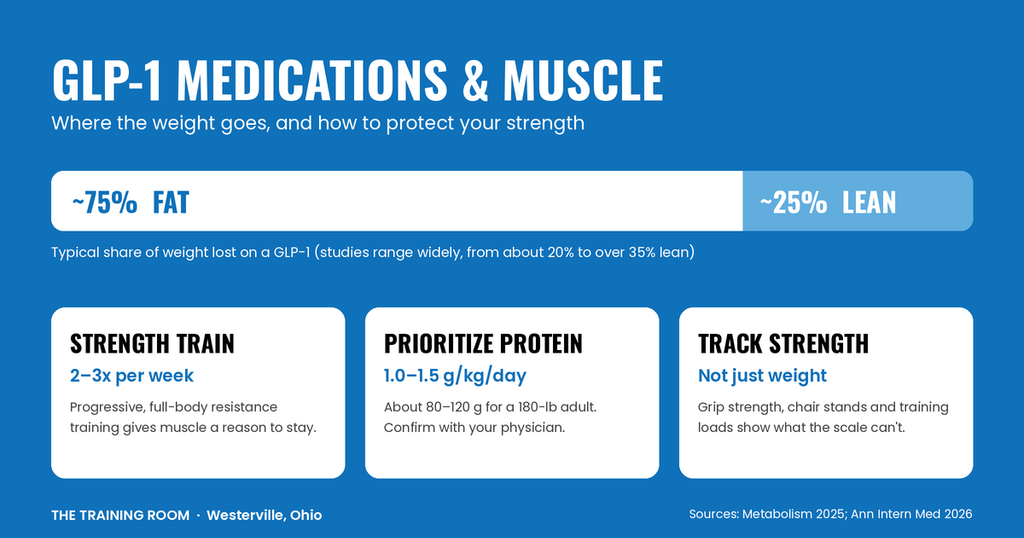
It's partly true. GLP-1 medications do reduce lean mass, usually about a quarter to a third of the total weight lost. But fat loss is much larger, and the research suggests the medication itself isn't the main problem. The real risk is losing weight passively, without giving your muscles a reason to stay. The solution is something we recommend to almost everyone over 40 anyway: progressive strength training and enough protein.
Here's what the science actually says, and what it means for you.
A Quick Primer on GLP-1 Medications
GLP-1 medications include semaglutide (Wegovy, Ozempic), tirzepatide (Zepbound, Mounjaro), and liraglutide (Saxenda, Victoza). They work largely by reducing appetite and slowing digestion, so people naturally eat less.
The results can be substantial. The newest medications produce average weight loss of roughly 15 to 20 percent in clinical trials, along with meaningful improvements in blood sugar, blood pressure, and other markers of metabolic health. For many people, these are genuinely valuable tools.
But "weight" is not one thing. It's fat, muscle, water, bone, and organ tissue. When the scale drops, the question worth asking is: what did I actually lose?
How Much Muscle Do People Lose?
The research is fairly consistent on the direction, if not the exact size.
A 2025 network meta-analysis of 22 randomized trials found that about 25 percent of the weight lost on GLP-1 medications came from lean mass. In practical terms, someone who loses 20 pounds might lose about 5 pounds of lean tissue and 15 pounds of fat.
The more powerful medications tend to produce more lean mass loss in absolute terms, simply because they produce more weight loss overall. In the SURMOUNT-1 trial, tirzepatide reduced fat mass by about 34 percent and lean mass by about 11 percent over 72 weeks.
A 2026 review in Annals of Internal Medicine looked at 36 trials and found a wider picture. The median share of weight lost from muscle-related measures was about 35 percent, but results ranged widely from study to study.
There is good news in these numbers. Because fat loss is so much larger, lean mass as a percentage of body weight usually stays the same or goes up. And the share of weight lost as lean mass looks broadly similar to what happens with dieting alone. Losing some lean tissue is a normal part of significant weight loss, no matter how you get there.
"Lean Mass" Isn't the Same as Muscle
This is an important detail that often gets lost in headlines.
Most studies measure body composition with DXA scans or bioelectrical impedance. These tools report "lean mass," which includes muscle but also water, organs, and connective tissue. A drop in lean mass is not the same as an equal drop in muscle.
Some of that change is also an expected adaptation. A body carrying 40 fewer pounds needs less supporting tissue to move around. That doesn't mean muscle loss should be ignored. It means the headline numbers likely overstate how much true muscle is being lost.
Does It Actually Make You Weaker?
The honest answer is that we don't know yet.
In the major trials, people generally reported that their physical function improved, which makes sense when you're carrying less weight. But objective strength and performance testing has been inconsistent. The 2026 Annals review found no trials that measured objective physical function at all.
The group researchers worry about most is older adults and people already at risk of sarcopenia, the age-related loss of muscle and strength. Observational data in older adults with type 2 diabetes have shown declines in muscle mass and grip strength on semaglutide.
For adults in their 40s, 50s, and 60s, this matters. Muscle gets harder to build and easier to lose with age. The strength you protect now supports the things you'll want to keep doing later: carrying luggage through an airport, climbing stairs without thinking about it, getting up from the floor after playing with grandkids, or keeping your golf swing.
Why Muscle Loss Happens (and Why That's Good News)
Current evidence suggests the medications don't directly break down muscle. The lean mass loss appears to come mainly from eating less, the same thing that happens with any large calorie deficit.
That's encouraging, because it means the same strategies that protect muscle during any weight loss should apply here too.
One study of people taking liraglutide found that about 18 percent lost 10 percent or more of their lean mass. Those people were more likely to have low protein intake, low physical activity, older age, insulin resistance, or low vitamin D. Several of those factors are within your control.
How to Protect Your Muscle on a GLP-1
Make Strength Training Non-Negotiable
Muscle responds to demand. When you lose weight without challenging your muscles, your body has little reason to hold onto them.
Most expert guidance recommends resistance training two to three times per week, covering all major muscle groups, with the challenge increasing gradually over time. That gradual increase is called progressive overload, and it's what tells your body that muscle is still needed.
The evidence here is still developing. Few trials have tested resistance training specifically alongside GLP-1 medications. But in a 2026 meta-analysis of lifestyle weight-loss programs, adding resistance training lowered the share of weight lost as lean mass from about 26 percent to about 18 percent. That's the strongest signal we have, and it points in a clear direction.
Prioritize Protein
This is harder than it sounds when your appetite is suppressed. Many people on GLP-1 medications find themselves eating very little, and protein often falls short.
A commonly used target is about 1.0 to 1.5 grams of protein per kilogram of body weight per day. For a 180-pound person, that's roughly 80 to 120 grams. These are expert-practice figures rather than proven thresholds, so talk with your physician or a registered dietitian about what's right for you, especially if you have kidney concerns.
Measure More Than the Scale
The scale can't tell you whether you're losing fat or muscle. Tracking strength gives you a much better picture. Is your grip strength holding? Can you stand up from a chair as easily? Are your training weights going up, holding steady, or dropping? Body composition scans, when available, add another useful layer.
Keep Your Prescriber in the Loop
Your physician manages the medication. Let them know you're strength training and share what you're noticing about your energy, strength, and appetite.
Why We Believe Coaching Matters on a GLP-1
At The Training Room, our position is straightforward. We're supportive of GLP-1 medications when they're appropriate. And we believe anyone taking one should be strength training, ideally with a qualified coach.
Here's why. Training on a GLP-1 comes with its own challenges. Appetite is lower, energy can fluctuate, and body weight keeps changing. A program has to be challenging enough to preserve muscle without being so demanding that it becomes unsustainable. Progression needs to be managed week to week, not guessed at.
A coach handles that for you. At our Westerville facility, we combine traditional free weights with Tonal digital resistance, which records the load on every set. That gives us a clear record of whether your strength is holding as your weight comes down, so we can adjust before small problems become big ones.
Whether you train one-on-one or in our semi-private format, the goal is the same: make sure the weight you lose is mostly fat, and keep the strength you need for the life you want.
The Bottom Line
GLP-1 medications can be powerful tools for weight loss and metabolic health. Some loss of lean mass comes with any significant weight loss, and these medications are no exception. The research doesn't support panic, but it does support action. Strength training, adequate protein, and tracking how strong you are, not just how much you weigh, give you the best chance of losing fat while keeping your muscle.
Take the Next Step
If you're on a GLP-1, or thinking about starting one, and want a plan to protect your strength, our coaches at The Training Room in Westerville can help. Schedule a No Sweat Intro to meet with a trainer, talk through your goals and experience, and get an expert recommendation for where to start.
Learn more about personal training in Westerville.
Frequently Asked Questions
Do GLP-1 medications cause muscle loss? They reduce lean mass, typically about a quarter to a third of the total weight lost. Fat loss is much larger, and the pattern is similar to other forms of significant weight loss.
Can I build muscle while taking a GLP-1? It can be harder in a large calorie deficit, but strength training and adequate protein give you the best chance of maintaining muscle and strength, and some people do gain strength during treatment.
How much protein should I eat on a GLP-1? A common target is 1.0 to 1.5 grams per kilogram of body weight per day. Confirm what's appropriate for you with your physician or a dietitian.
How often should I strength train on a GLP-1? Two to three sessions per week covering all major muscle groups is a practical starting point, progressed gradually over time.
Recent Comments