
Picture the first big trip of your retirement. You lift a carry-on into the overhead bin, walk the length of a long concourse, and the next morning climb a few hundred steps to a hilltop overlook. None of that feels like exercise. All of it depends on strength. Read more to learn about strength training after 50.
Strength training after 50 is one of the most effective ways to keep the muscle, strength, and bone that make everyday life possible, along with the activities you look forward to. Major exercise organizations recommend it, decades of research support it, and it works even if you have never lifted a weight. The key is training that progresses as you do.
Why Strength Becomes More Important After 50
Muscle changes gradually with age. Scientists use the term sarcopenia for the age-related loss of muscle mass and function. It rarely shows up as a single moment. It shows up as stairs that feel steeper, a grocery bag that feels heavier, or a golf drive that comes up a little short.
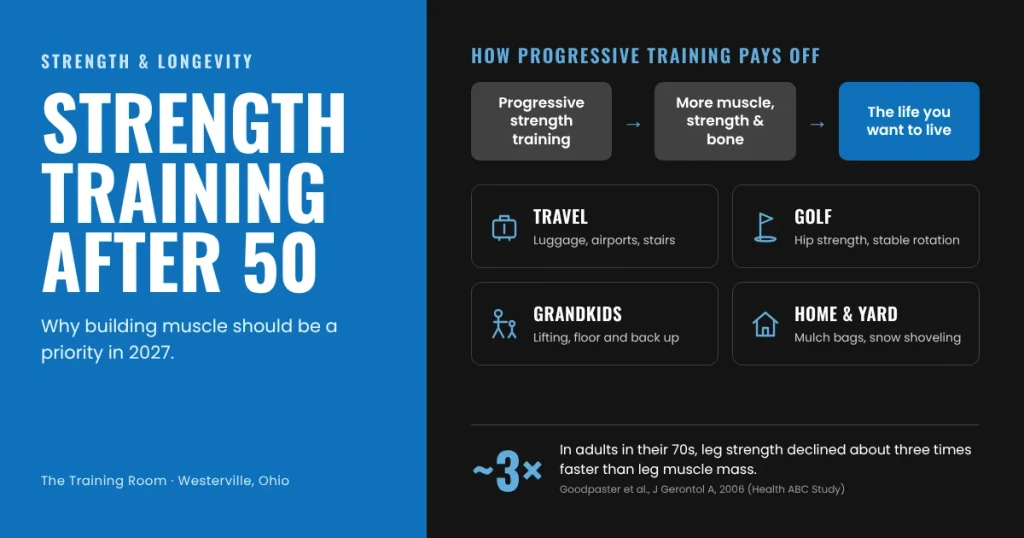
What surprises many people is that strength fades faster than muscle size. In the Health, Aging and Body Composition Study, researchers followed nearly 1,900 adults in their 70s for three years. Leg strength declined about 2.6% to 4.1% per year, roughly three times faster than the loss of leg muscle mass. Even people who held on to their muscle mass still lost strength.
That matters because strength is about more than muscle size. It also depends on how well your nervous system recruits muscle and how quickly you can produce force. Resistance training improves all of these. It is less about building bigger arms and more about keeping your body capable.
Strength also shows up in long-term health research. A 2022 review of 16 large studies found that adults who did muscle-strengthening activities had a 10% to 17% lower risk of death from any cause, heart disease, cancer, and diabetes. The largest benefit appeared at roughly 30 to 60 minutes per week. These studies show an association, not proof of cause and effect, but the pattern is consistent and encouraging.
Bone responds to load as well. In the LIFTMOR trial, postmenopausal women with low bone density completed eight months of supervised, twice-weekly, 30-minute strength sessions. They improved bone density at the spine and hip and performed better on everyday function tests than a low-intensity home exercise group.
Why 2027 Is the Right Time to Make Muscle a Priority
The best time to build strength is before you need it. A meta-analysis of 49 studies with more than 1,300 adults over age 50 found that resistance training added an average of about 2.4 pounds of lean body mass in roughly 20 weeks. Two details stood out. Programs with more total training volume produced larger gains, and older participants tended to gain somewhat less. Both point to the same conclusion: start sooner, and train with a plan that builds over time.
A new year is a natural planning point. Most people already set goals for travel, work, and family in January. Treating strength as one of those goals, with sessions on the calendar like any other appointment, is what turns good intentions into a habit you keep.
How Progressive Strength Training Supports the Life You Want
Your muscles adapt to the demands you place on them. Progressive overload simply means gradually increasing those demands over time: a little more weight, a few more repetitions, an extra set, or a more challenging version of a movement. Without progression, a routine that once built strength eventually only maintains it.
Here is how that progression connects to real life:
- Travel: Carrying luggage, walking airports, and climbing stairs at historic sites call on grip strength, leg strength, and endurance. Carries, split squats, and step-ups train exactly these.
- Golf and recreation: A consistent swing relies on strong hips, a stable trunk, and the ability to rotate with control. Hip hinges, rows, and controlled rotational work support it.
- Grandchildren: Lifting a toddler, getting down on the floor to play, and getting back up again are squat, hinge, and floor-transfer skills.
- Home and yard: Bags of mulch in the spring and snow shoveling during an Ohio winter are strength tasks too, and they go better with a strong back and legs.
The goal is not to train like an athlete. It is to train so that these activities stay easy, enjoyable, and safe for years to come.
What a Smart Strength Program After 50 Looks Like
The World Health Organization recommends muscle-strengthening activities for all major muscle groups on two or more days per week, at moderate or greater intensity. For older adults, it also recommends varied activity that emphasizes balance and strength on three or more days per week to support function and reduce fall risk.
In practice, a sound program usually includes a few consistent elements. It trains the major movement patterns: squatting, hinging at the hips, pushing, pulling, lunging or stepping, and carrying. Each set should be challenging enough that the last few repetitions take real effort while technique stays clean. And it progresses gradually, with the coach adjusting load, repetitions, or exercise difficulty as you adapt.
If you're wondering how often adults over 50 should lift, two or three well-planned sessions per week is a realistic and effective starting point for most people. Recovery matters as much as the workout, so sleep, adequate protein, and rest days are part of the plan.
Safety is a common worry, and an understandable one. The National Strength and Conditioning Association's position statement concludes that a properly designed resistance training program, with good technique instruction and supervision, is safe for healthy older adults. It also calls for an individualized approach. If you have a heart condition, recent surgery, or another health concern, talk with your physician before starting.
The Training Room Perspective
At The Training Room in Westerville, we see strength as a long-term investment rather than a short-term challenge. Every client starts with a conversation about goals, training history, and any health considerations. From there, our coaches build an individualized program, teach each movement, and progress it as you get stronger.
We combine Tonal digital resistance with dumbbells, kettlebells, cables, and other traditional equipment. Tonal lets our coaches adjust resistance in small steps and track progress session to session, which makes progressive overload measurable. Traditional free weights build the grip, balance, and coordination that everyday life demands. The equipment matters less than the coaching and the plan behind it.
We offer several ways to train. One-on-one personal training in Westerville gives you a coach's full attention. Semi-private personal training pairs an individualized program with a small shared setting of about three clients per coach. Small group training offers coach-led sessions with up to about five people. The right fit depends on your goals, experience, and how you like to train.
The Bottom Line
Strength training after 50 is not about chasing a younger version of yourself. It is about building the muscle, strength, and confidence to keep doing what you love, whether that is traveling, golfing, hiking, or keeping up with your grandchildren. A consistent, progressive program, two or three days a week, is one of the most practical health decisions you can make for the years ahead.
Start With a No Sweat Intro
If you'd like to make strength a priority in 2027, start with a conversation. A No Sweat Intro is a relaxed meeting with one of our trainers to talk through your goals, your experience, and any concerns. You'll leave with an expert recommendation on the training option that fits you best, whether that's one-on-one, semi-private, or small group training.
Schedule your No Sweat Intro with The Training Room
Frequently Asked Questions
Is it too late to start strength training after 60? No. Research on adults in their 60s, 70s, and beyond shows meaningful gains in strength and muscle with resistance training. Starting sooner helps, but starting at any age is better than not starting.
Is strength training safe for older adults? For healthy older adults, a well-designed program with proper technique instruction is considered safe by the National Strength and Conditioning Association. People with medical conditions should check with their physician first, and qualified coaching helps match exercises to individual needs.
How many days per week should I strength train after 50? The WHO recommends at least two days per week that work all major muscle groups. Many adults do well with two or three structured sessions, plus walking or other activity on other days.
Do I need to lift heavy weights to see results? You need weights that challenge you, not necessarily heavy ones on day one. A good program starts at a manageable level and increases the challenge gradually as your strength and technique improve.
Isn't walking enough? Walking is valuable for heart health and should stay in your routine. It does not provide enough resistance to maintain muscle strength on its own, which is why guidelines recommend both aerobic and muscle-strengthening activity.
References:
NSCA Position Statement: Resistance Training for Older Adults (Fragala et al., 2019)
WHO 2020 Guidelines on Physical Activity and Sedentary Behaviour (Bull et al.)
Peterson et al., 2011 meta-analysis on resistance exercise and lean body mass
Goodpaster et al., 2006, Health ABC Study on strength vs. muscle loss
Recent Comments